
On 3 March 2026, the General Assembly of the European Academy of Ophthalmology (EAO) was convened in an online format via Microsoft Teams. Participation was also possible in person at Gorczyczewskiego 2/7, Poznań, Poland; however, no participants chose this option.
Attendance
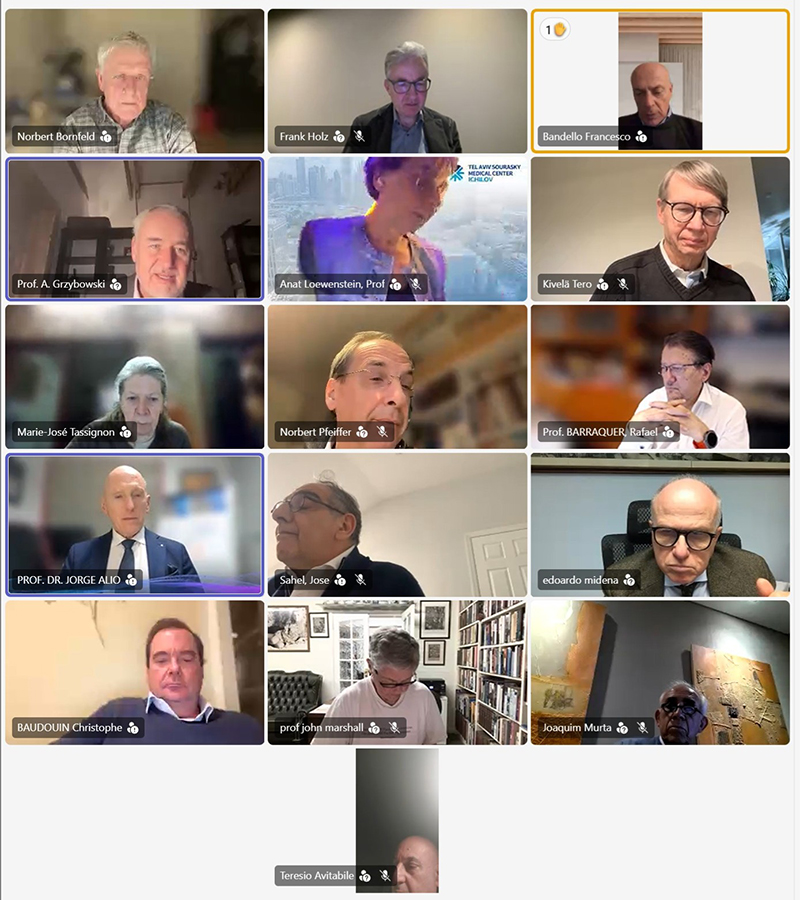
The meeting was attended by the following active members:
- Prof. Anat Loewenstein
- Prof. Francesco Bandello
- Prof. Christophe Baudouin
- Prof. Edoardo Midena
- Prof. Frank Holz
- Prof. Joaquim Murta
- Prof. Tero Kivelä
- Prof. Marie-José Tassignon
- Prof. Norbert Pfeiffer
- Prof. John Marshall
- Prof. Rafael Barraquer
- Prof. Jorge Alio
- Prof. José Sahel
- Prof. Teresio Avitabile
- Prof. Andrzej Grzybowski
- Prof. Zoltán Zsolt Nagy
Additionally, Prof. Norbert Bornfeld participated as a retired member.
Purpose of the Meeting
The purpose of the meeting was to review, discuss, and vote on proposed amendments to selected provisions of the EAO Statutes in order to update and streamline the Academy’s governance procedures.
1. Amendment to Article 14 – Status and Convening of the General Assembly
The following changes were proposed:
Current wording:
- At least ninety (90) days prior to the ordinary General Assembly and at least thirty (30) days prior to any extra-ordinary General Assembly, notice of the time and place shall be given to all members.
- Until forty five (45) days prior to any General Assembly each Voting Member is entitled to request by written notice to the Secretary-General additional items to be scheduled on the agenda of the following General Assembly.
Proposed amendment:
- At least thirty (30) days prior to the ordinary General Assembly and at least fifteen (15) days prior to any extra-ordinary General Assembly, notice of the time and place shall be given to all members.
- Until fifteen (15) days prior to any General Assembly each Voting Member is entitled to request by written notice to the Secretary-General additional items to be scheduled on the agenda of the following General Assembly. The proposal was discussed and subsequently put to a vote.
The amendments were approved unanimously.
2. Addition of a New Paragraph (Art. 14, para. 6)
It was proposed to add a new paragraph with the following wording:
“The General Assembly may be convened in person, virtually, or in a hybrid format.”
The proposal was discussed and put to a vote.
The amendment was approved unanimously.
3. Amendment to Article 17 – Universal Vote
Current wording (selected provision):
“The universal vote shall be conducted by the Secretary-General within three months. The Voting Members shall thereby cast their vote within forty-five (45) days from receipt of the complete voting papers.”
Proposed amendment:
“The universal vote shall be conducted by the Secretary-General within one month. The Voting Members shall thereby cast their vote within fifteen (15) days from receipt of the complete voting papers.”
The proposal was discussed and put to a vote.
The amendment was approved unanimously.
4. Amendment Concerning Quorum for Mail Ballots
Current wording:
“For any valid resolution of the General Assembly by mail ballot, the quorum is twenty-five (25) valid mail ballots of Voting Members timely returned to the Secretary-General.”
It was initially proposed to change to:
“For any valid resolution of the General Assembly by mail ballot, the quorum is thirteen (13) valid mail ballots of Voting Members timely returned to the Secretary-General”.
During the discussion, Prof. Francesco Bandello proposed replacing the fixed number with the formulation “50% + 1 member.”
This alternative proposal:
“For any valid resolution of the General Assembly by mail ballot, the quorum is 50% of all active members plus one valid mail ballots of Voting Members timely returned to the Secretary-General”
The proposal was put to a vote. The proposal to define the quorum as 50% + 1 Voting Member was approved unanimously.
Conclusion
All proposed amendments to the EAO Statutes were discussed thoroughly and adopted unanimously by the General Assembly. The approved changes aim to modernize procedural timelines, introduce flexibility in meeting formats, and adjust quorum requirements to better reflect the current structure of the Academy.